
 St. Louis, MO &
  View Discounts
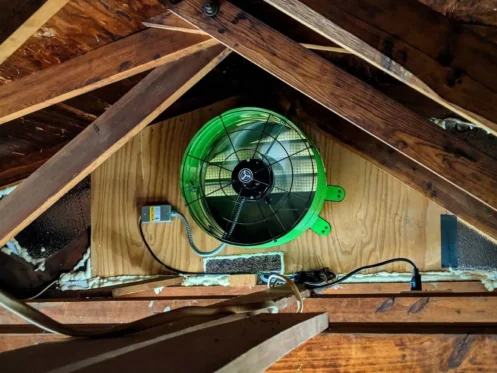
When you’re looking to cool your home or your attic, whole-house and attic fans are two common options. While both can improve airflow and cooling, they’re designed to work at different times of day. The right option for your home depends on your climate, your location and your cooling needs.
What’s the Difference Between a Whole-House Fan and an Attic Fan?
A whole-house fan cools both your home and attic, while an attic fan cools the attic alone. Both fans work by pushing hot air out of the house and replacing it with cooler outside air.
You might hear these terms often used interchangeably. That’s because whole-house fans were historically called attic fans. Today, however, they refer to two different products.
How Do Attic Fans and Whole-House Fans Work?
An attic fan features a vent with an integrated fan. It’s installed on the roof or a gable wall. When you turn on the fan, it pulls hot air out of the attic and sends it outside. This creates negative pressure in the attic, which pulls in cooler air from outside through your other attic vents.
A whole-house fan features a long duct that’s installed between your living space and your attic. The bottom end of the duct is connected to a ceiling vent in your home. The top end, which extends into your attic, is equipped with a fan.
Here’s how it works:
- You open your windows and turn on the fan.
- The fan pulls hot air from your house up into the ceiling vent.
- The hot air moves into the attic and out through the attic vents.
- The negative pressure from the fan pulls fresh, cool air into your home.
As the fan runs, it cools your home and creates a gentle breeze.
When Can You Use Whole-House and Attic Fans?
Attic fans usually run in the daytime, when the sun is the hottest. They remove some of the heat that rises to the top of your home, which can help reduce condensation and extend the lifetime of your roof.
Because whole-house fans replace hot indoor air with outdoor air, they can typically only be used when it’s cool outside — early morning, late evening and overnight. If you allow the fan to run long enough, it will eventually cool your space down to match the outside temperature.
Whole-House Fan vs. Attic Fan: How to Choose
In general, you should choose a whole-house fan only if you live in an area with significant temperature differences between day and night. These fans are less effective in extremely hot, humid areas.
Choose a whole-house fan if you want:
- Energy-efficient whole-house cooling: Whole-house systems use considerably less electricity than an air conditioner, which can reduce your energy costs at night in the summer.
- Thermal mass cooling: In addition to cooling the air, a whole-house fan cools the thermal mass of your home — the walls, furniture and flooring — at night. That means when you turn your AC on during the day, it doesn’t have to work as hard to cool your home.
- Better air quality: Because a whole-house fan replaces stale indoor air with fresh outdoor air, it can help remove dust, allergens and pet dander and improve air quality.
Attic fans, on the other hand, can be used in any area that experiences very high or low temperatures. That could include the upper midwest, the east coast and the southwest.
Choose an attic fan if you want:
- Lower summer AC bills: By running an attic fan during the day in the summer, you can reduce the temperature. This makes it easier for your AC to cool the second floor of your home, lowering energy usage and costs.
- Winter moisture management: Attic fans create constant airflow in the winter, which helps reduce moisture levels. This can help prevent mold, mildew, ice dams and wood rot.
- Manageable installation costs: Because it’s compact and simple, the cost to replace an attic fan or install a new unit is often lower than dealing with moisture or heat issues in your attic.
Can You Get Both a Whole-House and an Attic Fan?
Yes, you can install both an attic fan and a whole-house fan. This can be a great way to cool off your home on summer evenings, reduce attic temperature on hot summer days and manage moisture in the winter.
Installing Whole-House and Attic Fans
Not sure if a whole-house or an attic fan is best for your home? Wondering how to install an attic fan on your own? A professional HVAC technician can help. At Anton’s Plumbing, Heating/Cooling & Energy Experts, our team can inspect your house, recommend the right products and handle installation. To learn more, contact us today.


