 St. Louis, MO &
  View Discounts
If you’re looking to save on energy costs, attic insulation is a great option. According to ENERGY STAR, insulating and sealing air leaks can reduce your energy bills by up to 10%. But first, you need to decide which type of attic insulation is best for your home.
1. Batt or Roll Insulation
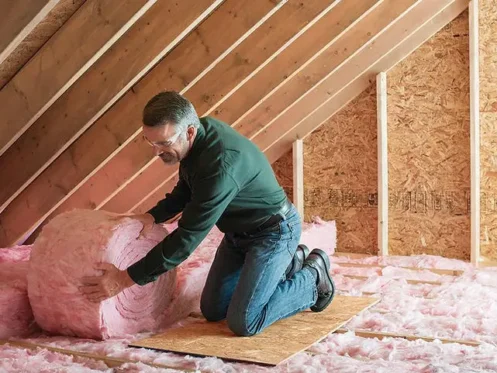
Batts (precut rectangular panels) and rolls are two of the most common types of attic insulation. They’re usually made from fiberglass, but you can also choose materials such as wool, cotton and plastic. You might choose this option if you want to control your attic insulation cost or if your attic mostly consists of large, uniformly shaped spaces.
Pros of batt or roll insulation:
- Affordable
- Easy to install in large areas
- Easy to replace
Cons of batt or roll insulation:
- Vulnerable to moisture
- Relatively low R-value (resistance to heat flow)
- Can be tough to fit into small or unusually shaped spaces
2. Foam Board Insulation
Foam board insulation comes in large, rigid sheets that are cut to fit your attic spaces. It’s thin and provides excellent insulation, making it a good option if you have shallow rafters or if your attic serves as a living space. You might also use foam board if your attic is humid or prone to moisture.
Pros of foam board insulation:
- High R-value
- Resistant to moisture
- Seals air leaks effectively
Cons of foam board insulation:
- Expensive
- Should be professionally installed
- Flammable and requires a thermal barrier for safety
3. Spray Foam Insulation
As you might guess from the name, spray foam insulation is sprayed into the space you want to insulate. It starts as a liquid and expands to fill cracks, crevices and odd-shaped spaces that are hard to reach with other types of insulation. Like foam board, spray foam provides excellent air sealing, insulation and soundproofing. And unlike loose-fill and batt or roll insulation, it doesn’t compress over time.
Pros of spray foam insulation:
- High R-value
- Long-lasting
- Can be used in attic roofs and floors
Cons of spray foam insulation:
- High-cost
- Requires professional installation
- Could conceal leaks and insects in roof
4. Loose-Fill/Blown-In Insulation
This type of insulation is typically made from small pieces of fiberglass, mineral wool or cellulose. It’s blown into the space, creating a soft layer of insulation. You might use this type of insulation to retrofit finished attic walls; you could also add it as a layer onto the floor of an unfinished attic. It’s also one of the most affordable attic insulation types, which is great if you’re on a budget.
Pros of loose-fill/blown-in insulation
- Often contains recycled materials
- Mid-range R-value
- Affordable
Cons of loose-fill/blown-in insulation
- Sensitive to moisture
- Can compress over time
- Dusty installation process could affect indoor air quality
5. Reflective or Radiant Barrier Insulation
If you live in a hot climate, a radiant barrier can reflect heat away from your home. This helps prevent heat gain when it’s warm outside, which creates a more comfortable interior environment. In areas with hot summers and cold winters, such as St. Louis, you can also pair reflective insulation with one of the other types of insulation for an attic. The combination can help you save energy year-round.
Pros of reflective or radiant barrier insulation:
- Reduces heat gain
- Lowers cooling costs
- Doesn’t compress or settle
Cons of reflective or radiant barrier insulation:
- Most effective in attics with large open spaces
- Not useful in cold climates
- May create moisture issues if not installed properly
Choosing the Right Type of Attic Insulation for Your Home
The best type of attic insulation depends on your budget, the structure of your home and your climate. If your attic has a variety of odd-shaped spaces, spray foam might be more effective than foam board. And if you’re on a tight budget, affordable products such as roll or batt insulation or blown-in insulation can prevent heat gain and loss without breaking the bank.
Not sure which option to choose? Contact us at Anton’s Plumbing, Heating/Cooling & Energy Experts. We can help you find the attic insulation that fits your needs.


